
Summer is in full swing, and the latest economic news brings a mix of encouraging and cautious signals. The U.S. lost jobs in July, while inflation continued to cool, making an immediate interest-rate increase less likely. The Federal Reserve kept rates unchanged for now, although policymakers remain divided on what should come next. Closer to home, Utah’s rental market showed mixed results, with performance continuing to vary by location. In this month’s update, we’ll also take a closer look at the new federal housing law and what it could mean for housing supply, institutional investors, and the rental industry.
Headlines
July Jobs Report - The U.S. economy lost 23,000 jobs in July, falling well below expectations for an 83,000 increase. Job losses were concentrated in government, retail, and leisure and hospitality, while healthcare and construction continued to add positions. Although unemployment edged down to 4.1%, this was largely because fewer people were working or actively looking for work. Annual wage growth also slowed to 3.2%, its lowest level since May 2021. Overall, the report points to a weakening labor market and could reduce the likelihood of a near-term Federal Reserve rate increase.
Weekly Jobless Claims - New unemployment claims rose by 9,000 to 209,000 for the week ending August 8, while continuing claims declined by 22,000 to 1.777 million. Although new filings increased, overall claims remain relatively low, pointing to a stable but slow-moving labor market where employers are limiting both hiring and layoffs. In Utah, advance claims increased slightly from 1,250 to 1,263, a weekly rise of only 13 claims, further indicating that layoffs across the state remain limited.
Consumer Price Index - After consumer prices fell 0.4% in June, annual inflation declined from 4.2% to 3.5%. Prices then rose a modest 0.1% in July, while annual inflation eased further to 3.4% and core inflation declined to 2.5%. Lower energy prices continued to provide relief, while shelter costs increased only slightly. Although inflation remains above the Federal Reserve’s 2% target, two consecutive months of improvement combined with signs of a weakening labor market, have reduced expectations for an interest-rate increase in September.
Fed Meeting - The Federal Reserve voted 9–3 to keep its benchmark interest rate at 3.5%–3.75%. The three dissenting members favored a quarter-point increase, reflecting growing concern that inflation remains above the Fed’s 2% target. Policymakers are closely watching continued pressure from tariffs and energy costs, and they have projected one possible rate increase before the end of 2026

Historic Housing Law Reshapes the Rental Industry
The 21st Century ROAD to Housing Act became law on July 11 without the President’s signature after receiving strong bipartisan support in Congress. Described as the most significant federal housing legislation in decades, the law aims to increase housing supply, reduce development barriers, and improve affordability for renters and homebuyers.
Several provisions focus on making housing construction faster and easier. The law directs HUD to publish best practices for modernizing local zoning, streamlines environmental reviews for smaller and infill housing projects, and establishes a pilot program that rewards participating communities for supporting new development.
For the rental industry, the law reduces duplicate inspections by allowing an approved inspection to satisfy requirements across certain federal housing programs. It also modernizes and reauthorizes the HOME Investment Partnerships Program to improve administration and support the construction and preservation of affordable housing. These changes are intended to reduce delays and make federal housing programs more efficient.
The law also restricts institutional investors that own 350 or more single-family homes from purchasing additional existing properties. However, exceptions allow continued investment through build-to-rent developments, substantial renovations, tenant purchase opportunities, and certain transactions between large landlords. A proposed requirement that would have forced build-to-rent owners to sell properties after seven years was removed from the final law.
Most individual and small-scale rental-property owners are not directly affected by the institutional-investor restriction. However, the law could gradually increase housing supply and competition while encouraging more build-to-rent development. Its full impact will depend on how federal agencies implement the new programs, and owners should continue monitoring potential state-level restrictions and regulatory changes affecting the rental market.
Utah Real Estate Market
Utah’s housing market remained active in July, although prices and monthly sales softened slightly as inventory continued to grow. The median sold price declined to $620,000, down 1.57% from June and 0.57% from a year ago. A total of 1,676 properties sold, representing a 1.82% monthly decrease but a strong increase year over year. Meanwhile, active listings rose to 7,661, up 3.46% from June, giving buyers more options. Overall, July showed a more balanced market, with increased inventory and steady buyer activity despite modest price cooling.
| Median Sold Price* | Sold Count* | Average # of Listings* |
|---|---|---|
| July: 623,563 August: 605,000 September: 610,000 October: 600,000 November: 599,945 December: 610,000 January: 595,000 February: 588,397 March: 597,970 April: 615,000 May: 615,230 June: 629,900 July: 620,000 | July: 1,530 August: 1,604 September: 1,445 October: 1,545 November: 1,164 December: 1,397 January: 969 February: 1,246 March: 1,574 April: 1,574 May: 1,695 June: 1,707 July: 1,676 | July: 7,207 August: 7,295 September: 7,288 October: 7,208 November: 7,111 December: 5,515 January: 5,587 February: 5,554 March: 5,794 April: 6,287 May: 7,031 June: 7,405 July: 7,661 |
| Monthly Change: Down 1.57% Year Over Year: Down 0.57% | Monthly Change: Down 1.82% Year Over Year: Up 9.54% | Monthly Change: Up 3.46% Year Over Year: Up 6.30% |
* all graphs/data are for single-family homes in Salt Lake, Utah, and Davis Counties.
Rent Report
Utah’s rental market softened slightly in July, with statewide rents declining 0.1% month over month and 1.7% year over year. At the county level, Davis County recorded the strongest growth, rising 0.7% monthly and 2.8% annually, while Utah County increased 0.5% for the month but remained nearly flat year over year. Salt Lake County declined both monthly and annually. City-level results were mixed, with Layton and Taylorsville leading monthly growth. Layton was also the strongest year-over-year performer, with rents up 10.6%. Overall, Utah’s rental market remains relatively stable, although performance continues to vary by location.
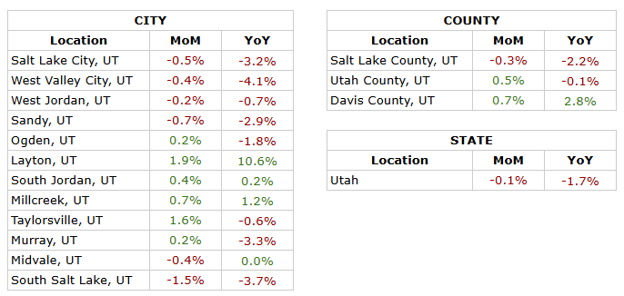
*Rental data provided by apartment list.
Industry Updates
HUD Withdraws Fair Housing Guidance - On July 17, HUD withdrew several guidance documents covering criminal background screening, limited English proficiency, source-of-income restrictions, land-use practices, federally assisted housing, and other fair housing matters. The move is part of a broader federal deregulation effort intended to simplify compliance expectations for housing providers. However, the withdrawal does not repeal or change federal, state, or local fair housing laws. Property owners and housing providers should continue following all applicable requirements, review existing policies with qualified counsel when needed, and watch for new HUD regulations or replacement guidance.
New Supply Reshapes the U.S. Rental Market - Single-family rents continue to outperform multifamily rents, rising 2.8% year over year in June, compared with 1.4% for multifamily properties. The national rent gap between the two property types has widened to 29.7%, more than double its pre-pandemic level. Since January 2020, multifamily rents have increased 33% nationally, while Salt Lake City recorded a much larger 67% increase. However, a surge in new rental construction and slower population growth are increasing competition and limiting further rent growth. These conditions make competitive pricing and property quality increasingly important for rental owners.
Summarize this content with AI:
Chat GPTGrok
Perplexity
Claude.ai