
As summer rolls on, the US economy is showing mixed signals. Job growth slowed significantly in June, prompting the Federal Reserve to maintain a cautious approach and keep interest rates unchanged. Ongoing tensions in the middle east have kept energy prices volatile so the Fed will likely continue to closely monitor inflation in the economy before considering any rate cuts. Here in Utah, the housing market remains steady, with home prices and inventory continuing to grow while rental rates show modest monthly gains. Finally, in this month's update, we'll take a closer look at HUD's new guidance on assistance animals and what it means for property owners in Utah.
Headlines
June Jobs Report - The U.S. labor market slowed in June, with employers adding 57,000 jobs. This was far fewer than expected and marks a significant step down from the 129,000 jobs added in May, however the overall unemployment rate edged down to 4.2%. Wage growth remained steady at 3.5% year over year, and most new jobs came from professional services, healthcare, and social assistance. Although hiring has cooled, the labor market remains relatively stable, supporting continued rental demand. The slower pace of job growth also reduces the likelihood of additional interest rate increases in the near term, which could help keep borrowing costs and the housing market more stable in the months ahead.
Weekly Jobless Claims - The U.S. labor market remained stable in early July, with new unemployment claims falling to 215,000, signaling that employers continue to hire cautiously while avoiding widespread layoffs despite slower job growth in June. Economists describe the current environment as a "slow-hire, slow-fire" labor market, where employment remains resilient even as hiring activity moderates. The Federal Reserve also expects labor market conditions to remain stable in the near term as it continues to monitor inflation and broader economic conditions. Here in Utah, unemployment claims remained unchanged at 1,163 for the week, further reflecting the state's stable labor market and continued economic resilience.
Consumer Price Index - The next Consumer Price Index (CPI) report will be released on July 14, after this month's Owner Update is published, so we'll cover those results next month. As a quick recap, May inflation rose to 4.2% year over year, largely due to higher energy prices, while core inflation remained more moderate at 2.9%. The report reinforced expectations that the Federal Reserve would keep interest rates unchanged while continuing to monitor inflation trends.
Fed Meeting - The Federal Reserve kept its benchmark interest rate unchanged at 3.5%–3.75% during its June meeting, citing a stable labor market and inflation that remains above its 2% target. Under new Fed Chair Kevin Warsh, the central bank signaled a more cautious approach by removing previous language that suggested future rate cuts and indicating that a rate increase is possible if inflation remains elevated. For now, the Fed will continue monitoring inflation and economic conditions before making any changes to interest rates.

HUD Tightens Guidance on Assistance Animals, But Utah Rules Remain Unchanged
HUD has announced a significant change to how it will enforce assistance animal requests under the Fair Housing Act, marking one of the biggest fair housing developments for housing providers in recent years.
On May 22, HUD issued a new enforcement memorandum stating that, in most cases, tenants requesting an assistance animal must not only demonstrate that they have a disability and that the animal assists with that disability, but also show that the animal has received individualized training related to the person's disability. This represents a notable shift from previous federal guidance, which generally required only documentation of a disability and a disability-related need for the animal. HUD also cited the growing number of online providers offering generic ESA letters with little or no clinical evaluation as one reason for updating its enforcement approach.
For property owners, this change may provide greater support when reviewing questionable assistance animal requests and could help reduce fraudulent Emotional Support Animal (ESA) claims. However, it is important to understand that this memorandum is enforcement guidance, not a new federal law. The Fair Housing Act itself has not been amended, and HUD has indicated that formal rulemaking will follow before any permanent regulatory changes are adopted.
Most importantly for Utah property owners, this guidance does not override Utah law. The Utah Antidiscrimination and Labor Division (UALD) has confirmed that it will continue applying its current interpretation of the Utah Fair Housing Act, which follows the longstanding federal standard for Emotional Support Animals. As a result, housing providers in Utah must continue screening and evaluating ESA requests using their existing procedures. At this time, it is not recommended that we begin charging pet rent, pet deposits, or pet fees for approved ESAs solely because of HUD's new memorandum.
Industry organizations, including the Utah Rental Housing Association (URHA), are actively working with state lawmakers to align Utah's requirements with the updated federal enforcement guidance. Until legislative or regulatory changes occur, we will maintain the status quo, but this is definitely a step in the right direction when it comes to protecting those with disabilities while also preventing fraudulent ESA claims.
Utah Real Estate Market
Utah's housing market remained healthy in June, with home prices continuing to rise alongside steady sales activity and increasing inventory. The median sold price reached $629,900, up 2.38% from May and 2.42% from a year ago, reflecting continued strength in home values. Home sales also increased slightly, with 1,707 properties sold, while active listings climbed to 7,405, giving buyers more choices and contributing to a more balanced market. Overall, June continued the trend of stable price growth supported by healthy inventory and consistent buyer demand.
Median Sold Price* | Sold Count* | Average # of Listings* |
June: 615,000 July: 623,563 August: 605,000 September: 610,000 October: 600,000 November: 599,945 December: 610,000 January: 595,000 February: 588,397 March: 597,970 April: 615,000 May: 615,230 June: 629,900 | June: 1,565 July: 1,530 August: 1,604 September: 1,445 October: 1,545 November: 1,164 December: 1,397 January: 969 February: 1,246 March: 1,574 April: 1,574 May: 1,695 June: 1,707 | June: 7,042 July: 7,207 August: 7,295 September: 7,288 October: 7,208 November: 7,111 December: 5,515 January: 5,587 February: 5,554 March: 5,794 April: 6,287 May: 7,031 June: 7,405 |
Monthly Change: Up 2.38% Year Over Year: Up 2.42% | Monthly Change: 0.71% Year Over Year: Up 9.07% | Monthly Change: Up 5.32% Year Over Year: Up 5.15% |
* all graphs/data are for single-family homes in Salt Lake, Utah, and Davis Counties.
Rent Report
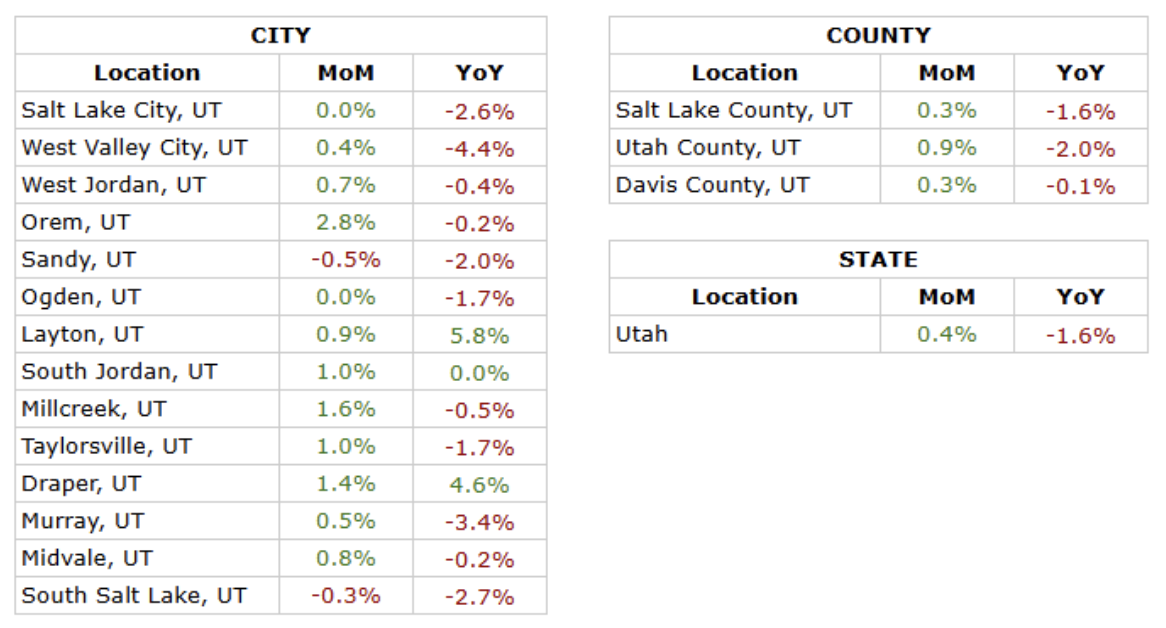
Utah's rental market remained stable in June, with statewide rents increasing 0.4% month over month, although they remained 1.6% lower than a year ago. At the county level, Utah County led monthly growth with a 0.9% increase, while Salt Lake County and Davis County each posted modest gains of 0.3%. Despite the monthly improvements, all three counties continued to record slightly lower rents compared to last year. At the city level, most markets experienced positive monthly rent growth, led by Orem, Millcreek, and Draper. Layton and Draper remained the strongest performers year over year, while most other cities continued to see rents below June 2025 levels. Overall, monthly rent growth remains positive, signaling continued stability across Utah's rental market.
* Rental data provided by apartment list.
Industry Updates
2026 State of the Nation’s Housing - The 2026 State of the Nation's Housing Report highlights a housing market that remains challenged by high costs, elevated mortgage rates, and slowing demand. While new housing construction has helped increase both rental and for-sale inventory, affordability continues to limit homebuying activity, keeping many households in the rental market longer. The report also notes that lower-cost housing remains in short supply, with millions of renters continuing to face high housing costs. Looking ahead, federal, state, and local governments are increasing efforts to expand housing supply through zoning reforms, streamlined development processes, and new affordable housing initiatives.
Latest Update on 21st Century ROAD to Housing Act - Congress has approved the bipartisan 21st Century ROAD to Housing Act, one of the most significant federal housing packages in decades, and the bill is now awaiting the President's signature. If no action is taken, it is expected to become law as early as July 9. The legislation focuses on increasing housing supply and improving affordability by streamlining housing development, modernizing affordable housing programs, encouraging zoning reforms, and reducing regulatory barriers. It also preserves protections for build-to-rent housing, a key priority for the rental housing industry. If enacted, the law is expected to support the construction of more housing and help improve affordability over the long term.
Summarize this content with AI:
Chat GPTGrok
Perplexity
Claude.ai